A music supplement makes sense when it can show accomplished playing that your activities list cannot convey. You do not need to plan a music major, but you do need suitable recordings, an accepted submission category and enough time to finish the application itself. If meeting those conditions would require learning a new programme in a few weeks, leaving the supplement out is a reasonable decision.
Stanford and Princeton illustrate why this choice needs to happen early. Their optional music submissions serve a similar purpose, but their deadlines and recording instructions differ. The comparison below concerns first-year Regular Decision applications for fall 2027 entry, with requirements checked on 16 November 2026.
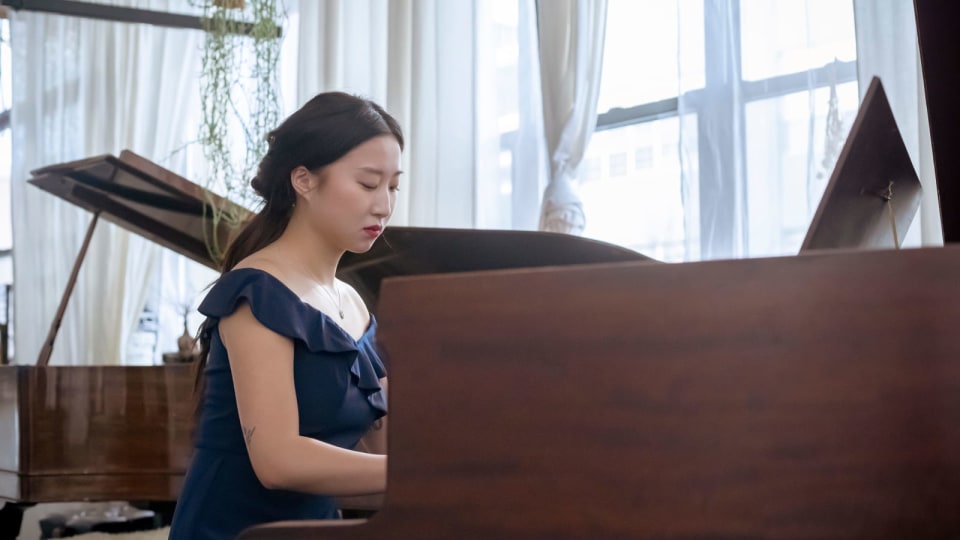
Featured photograph: SHVETS production / Pexels.
What the supplement adds to an application
An activities entry can describe years of lessons, ensemble responsibilities and performances. A recording lets a specialist consider the music itself: your control of rhythm and sound, your phrasing, and what you do with the repertoire. That is the reason to submit. An impressive work title or a long list of awards cannot make those qualities audible on its own.
Stanford’s music portfolio guidance makes clear that this is an optional part of applying to the university, including for students who expect to study another subject. It is not an audition for admission to the music major. Its portfolio FAQ says applicants follow the same instructions regardless of intended major, and that submitting or omitting a portfolio does not attract a penalty. The portfolio is one consideration among many.
Princeton similarly invites accomplished musicians to add work to their university application. Its admissions FAQ explains that arts faculty can evaluate submissions and advise the admissions staff. Neither description provides a formula for an admissions advantage. A teacher can help you judge the playing; they cannot turn a musical assessment into an admission prediction.
If you are applying to a performance degree with prescribed audition repertoire, you have a different task. Our piano prescreening guide for 2027 entry covers that route. Do not import a conservatory’s repertoire list into an optional supplement unless the college actually asks for it.
Make the decision from a recording you can produce now
Start with a complete run of two pieces already in your repertoire. An ordinary phone recording is enough for this first decision. Play through each one without restarting, then listen away from the instrument. You are asking whether the musical decisions survive a complete performance, rather than whether isolated difficult bars can work after several attempts.
First, does the playing represent your current strengths? Listen for a reliable pulse, intentional phrase endings and a clear main line. Notice where accuracy problems interfere with those things. The question is not whether you can find a take without a single blemish. It is whether the performance communicates something coherent across the whole piece.
Bring that recording to your regular teacher, if you have one. Ask something specific: “Do these pieces show my strongest playing, and which passage most weakens the performance?” That conversation is more useful than asking whether you are “college level,” a phrase that hides very different expectations. Without a teacher available, a musician who knows your instrument can still help identify unclear sound, unstable tempo or a repertoire mismatch. They are helping with preparation, not delivering an admissions verdict.
Second, can the college evaluate what you do? Check the actual instrument and genre list before arranging a session. Stanford’s eligible music areas and Princeton’s music categories reflect their teaching expertise. The presence of a broad “music” heading does not mean every tradition or kind of submission is assessed in the same way.
Third, can you finish without sacrificing the main application? Count the unglamorous work too: arranging a room or accompanist, making a test recording, choosing files, writing the music résumé and checking the upload. If your only suitable work is still being learned, or the recording plan depends on borrowing equipment at the last minute, that is a practical reason to pause.
There is no need to manufacture a supplement to prove that music matters to you. You can describe sustained participation accurately in the main application. Conversely, being a prospective engineer or historian is not itself a reason to withhold strong musical work.
Stanford moves the application deadline forward
The most consequential difference comes before you upload a note. At Stanford, the Regular Decision arts route requires the Common Application on 5 December. Waiting for the usual January deadline would miss that route.
| College | Application for this arts route | Music materials |
|---|---|---|
| Stanford First-year dates | 5 December 2026 | 10 December 2026 |
| Princeton First-year dates | 1 January 2027 | 8 January 2027 |
Stanford’s 5 January 2027 date is the standard Regular Decision application deadline without an arts portfolio. For the arts route, school reports, transcripts and the required teacher and counsellor recommendations may still arrive by that January date. The earlier application deadline does not bring every school document forward. Stanford states that Common Applications are due by 11:59 p.m. in the applicant’s local time; check the portfolio instructions in your portal for the upload cutoff. See the expanded Regular Decision instructions.
Princeton’s supplement is due by 11:59 p.m. in your local time on 8 January. That extra week does not extend the application deadline. Its supplement page gives the upload time, while the application calendar above lists the January application requirements.
At Stanford, indicate the portfolio intention in the Common Application. After submitting, use the Stanford portal’s Optional Arts Portfolio form, then its materials-upload link. The central admissions instructions say portal access normally arrives by email within 48 hours. At Princeton, indicate the intention in its application questions and submit the application first; the Applicant Status Portal route then becomes available. Plan for that sequence instead of treating the final day as both application day and recording day.
These dates are for Regular Decision. Early applicants and transfer applicants have different schedules, and QuestBridge Match has separate restrictions. Use the college’s instructions for your application route.
The same recordings may need two different programmes
For Stanford performance submissions, prepare video, not audio alone. The music department suggests two or three contrasting pieces in one performance area. Ten minutes is a suggested combined length, not a hard maximum; faculty may review ten minutes or less. Videos should be no more than a year old, and separate files are allowed. Those distinctions come from the music portfolio FAQ.
Princeton accepts audio or video. Its piano category asks for 10–15 minutes of solo recordings, with contrasting styles recommended. Music applicants must also upload a separate music résumé and a statement of no more than 250 words about integrating music-making and ensemble contributions into their Princeton studies. Read the instructions for your exact music category: the piano duration is not a rule for every applicant. Voice has its own song and language requirements; jazz asks for improvisation rather than performances of transcribed solos.
This is why “make a ten-minute music video” is poor universal advice. For a pianist considering these two colleges, the useful starting point is a small pool of complete, well-prepared pieces, followed by a separate selection for each destination.
Here is an illustrative planning example, not a real applicant’s portfolio or a college-approved repertoire list. Imagine a pianist who already knows the following three works. The durations are hypothetical, chosen to show the arithmetic; use the lengths of your own complete takes.
Bach: Prelude and Fugue in C minor, BWV 847
Assumed duration: 3:40. A chance to demonstrate rhythmic clarity and distinct contrapuntal voices.
Chopin: Nocturne in D-flat major, Op. 27 No. 2
Assumed duration: 6:00. A contrasting opportunity to sustain a melodic line and balance it against the accompaniment.
Debussy: Toccata from Pour le piano
Assumed duration: 4:05. Fast movement adds another kind of articulation and coordination, provided the performance is already secure.
The Bach and Chopin total 9:40, close to Stanford’s suggested length. Adding the Debussy produces 13:45, within Princeton’s piano range. These totals include both the prelude and fugue in the Bach pairing. They do not depend on cutting pieces halfway through or playing faster to meet the clock.
The selection still needs musical judgment. If the Debussy falls apart near the end, its presence does not improve the programme simply because it supplies enough minutes. A different, equally prepared work may solve the problem. If nothing suitable is ready, the Princeton supplement may not be practical this cycle. Equally, if the Chopin is the least convincing performance, do not keep it merely because slow and fast pieces make a tidy contrast on paper.
Choose the opening file for the quality of the playing it reveals. A difficult piece with an unsettled opening is a poor way to introduce yourself. “Contrasting” should describe audible differences in texture, articulation or character, not just three composers’ names.
Give the recording a small, realistic preparation window
For the example above, a sensible November plan begins by confirming the repertoire with a complete recording this week. Use the following week to address a few specific problems and test the final room and camera position. Record the intended files before the end of November, leaving early December for listening, paperwork and technical problems.
A personal target of 2 December for the Stanford application and 7 December for the portfolio leaves a little room before the published deadlines. These are planning targets, not additional college requirements. If Princeton is also on the list, submit its application comfortably before 1 January and leave several days before 8 January to check the supplement. You need not record the entire programme again merely because a second college has a later deadline.
Keep a short preparation note for each piece. “Fugue: middle entry disappears at bar 12; bring that voice forward in the next run” gives tomorrow’s practice a purpose. “Needs work” does not. After the next complete take, check whether the change survives at performance tempo. Our guide to practising for performance explains how to make that transition from isolated repair to a continuous run.
Before the recording session, test a short loud passage and a quiet one. Listen back for distortion, a melody buried by the accompaniment, and room noise that masks detail. Check the picture as well as the sound: the player should be identifiable, with a useful view of the performance. A simple, stable recording that lets someone assess the music is the aim.
Keep each piece as an honest continuous performance and follow the destination’s editing rules. Stanford explicitly disallows overlays or other edits that manipulate the performance; if using prerecorded accompaniment, its accompaniment guidance permits playing it through a speaker in the room. Do not assume that a polished audio production is interchangeable with a performance submission.
When choosing takes, listen once for continuity and once for the musical qualities you meant to show. Write down the passage and the issue before deciding to record again. That keeps the process from becoming an endless hunt for a flawless opening while the rest of the piece receives less attention. The listening habits in our guide to learning from recordings can help turn a vague reaction into a specific observation.
Let the supporting materials explain the music
A useful music résumé is selective and factual: who you have studied with, significant ensemble work, performances, relevant awards and repertoire. Give dates and describe your role plainly. “Principal second violin, school orchestra, 2025–26” tells a reader more than a paragraph about lifelong passion. Stanford’s recording and supporting-material guidance includes the music résumé among the portfolio materials.
For Princeton’s short statement, connect a real musical habit to the way you would like to participate. A pianist who regularly rehearses with singers can explain what that collaboration involves and why they want to continue it alongside another subject. Research an actual opportunity before naming it, and distinguish an intention to audition or participate from a place you have already secured. The strongest material is specific enough that it could only describe your own experience.
An optional arts reference is separate from the required academic recommendations. If you want one, arrange it early and use the college’s designated request route. Stanford’s optional music reference is due with the portfolio on 10 December, as its arts instructions explain. Princeton’s arts-reference FAQ describes the request in the portfolio tab. Listing a teacher’s name in your résumé does not send them a request.
Open the uploaded files from beginning to end before final submission. Check titles, composer and work numbers, sound, picture, and access to any permitted external media. Princeton does not allow changes after the supplement is submitted. Its portal should show receipt within 24 hours, according to the submission FAQ. Keep the confirmation and a copy of exactly what you sent.
If you decide against the supplement, use the time on the application and keep making music. The decision is about whether this particular submission represents your work well, within this college’s rules and this year’s timetable. It does not decide whether music belongs in your life at university.