
Can You Actually Improve by Practicing in Your Head? What Mental Practice Research Says
Mental practice for musicians is not pseudoscience, but it is not magic either. This guide looks at what motor imagery research actually shows, where off-instrument practice helps most, and how to use it without fooling yourself.
Pract.is
Research-based practice guidance from the Pract.is team.

Mental practice works. The catch is that most musicians use the phrase too loosely.
Running a vague movie of your hands on the train is not the same thing as targeted motor imagery. The research is much more interesting than the usual “visualization works” cliché: off-instrument rehearsal can change the brain, help memory, and improve performance, but it works best when the imagery is precise, auditory, and tied to music you already understand physically.
Important note: this piece was written on March 12, 2026 using primary research sources, including Pascual-Leone et al. in the Journal of Neurophysiology, Bernardi et al. in Music Perception, Endestad et al. in Frontiers in Human Neuroscience, and the motor-imagery review by Guillot et al. in Progress in Brain Research. The goal here is not to sell mental practice as magic. It is to make the research usable.
The Short Answer
Mental practice can help, but not for everything. This is the practical version.
| Goal | How much mental practice helps | Why |
|---|---|---|
| Memorization and score study | A lot | Auditory imagery and structural understanding transfer well away from the instrument |
| Preparing familiar passages | Often useful | The brain can rehearse movement plans and musical sequences without sound output or physical load |
| Brand-new technical motions | Limited | You cannot mentally refine what you do not yet physically understand |
| Replacing all physical practice | Not realistic | Real playing still matters for touch, timing, tone production, and error correction |
What the Research Actually Shows
The classic reference point is the 1995 study by Pascual-Leone and colleagues. They had subjects learn a simple five-finger piano exercise either through physical practice or through mental rehearsal alone. Using transcranial magnetic stimulation, they found that both groups showed changes in the motor cortex. Physical practice produced the larger effect, but mental practice still changed the map.
That matters because it cuts through the lazy version of the debate. Off-instrument rehearsal is not “nothing.” The brain does not wait for sound in the room before it starts building and refining motor plans.
The more musician-specific evidence is just as interesting. Bernardi and colleagues studied pianists memorizing Scarlatti sonatas and found that mental practice alone could support learning, while the strongest results came from mental work combined with physical practice. Their paper is especially useful because it goes beyond the simple question of “does it work?” and gets into how it works.
The strongest predictors were not flashy visualization tricks. They were auditory imagery and formal analysis. In other words, mentally hearing the piece and understanding its structure mattered more than imagining an internal video of your fingers.
Endestad and colleagues add another layer. In a 2020 case study on a concert pianist, they compared actual playing, silent playing, listening, and imagining. The point was not that all four states were identical. They were not. The point was that they recruited overlapping resources and measurable mental effort. Playing, hearing, and imagining music sit much closer together in the brain than many musicians assume.

Photo: cottonbro studio via Pexels
Why Mental Practice Works Better for Some Musicians Than Others
This is where the internet usually gets sloppy. Mental practice is not equally effective for every player at every stage.
The better your internal representation of the task, the more useful imagery becomes. That is one reason the strongest music studies often use trained pianists rather than total beginners. If a player already has some technical and auditory map of the piece, mental rehearsal has something real to simulate.
If a beginner has never played a trill cleanly, never felt a balanced wrist through an arpeggio, and cannot yet hear the phrase internally, mental practice has much less to work with. The problem is not that the beginner lacks imagination. The problem is that the brain cannot simulate a movement pattern very well when the underlying model is weak.
This is the honest middle ground: mental practice is usually most powerful as a multiplier for existing skill, not as a substitute for building that skill from zero.
What Effective Mental Practice Actually Looks Like
Most musicians should stop thinking of mental practice as “seeing the keyboard in your head.” The research points toward a more useful method.
1. Hear the passage internally
The core skill is auditory imagery. Hear the notes, rhythm, dynamics, articulation, and pacing internally with as much precision as possible. If the sound in your head goes fuzzy, that is not failure. It is diagnostic information. It tells you exactly what is not really learned yet.
2. Track the structure at the same time
Bernardi's study is especially good on this point. Mental rehearsal gets stronger when it is paired with formal understanding: harmony, phrase structure, cadences, modulations, patterns, and landmarks. This is why score study away from the instrument is so useful for memory.
3. Rehearse specific problem spots, not just whole runs
Off-instrument work can become as lazy as physical practice if it turns into a vague top-to-bottom run-through. Use it deliberately. Isolate the transition into the recapitulation. Rehearse the left-hand leap that always feels unstable. Mentally restart from random bars, exactly like the test-based memorization approach that works so well at the instrument.
4. Use it to prepare the next physical session
The best use of mental practice is often not “I practiced instead of playing.” It is “I prepared the next real session so I waste less time when I sit down.” That is a much more practical and much less mystical way to use it.
Where Mental Practice Helps Most in Real Life
The strongest use cases are boring in the best possible way.
- Travel: trains, planes, waiting rooms, backstage time.
- Memorization: hearing and structurally mapping a piece away from the instrument.
- Pre-performance preparation: calmly walking through entrances, transitions, and recoveries before going on stage.
- Low-load days: when the body needs less playing time but the mind can still work.
This is also one reason mental practice pairs well with performance-anxiety work. Not because it removes nerves by magic, but because it gives the mind a more stable route through the material before pressure rises.
And if you are using it regularly, log it as a real practice category rather than pretending it does not count. A tool like Pract.is is useful here because it makes the split between physical work, score study, and mental rehearsal visible instead of vague.
What Mental Practice Does Not Do Well
It does not replace touch.
It does not teach the hand what a key actually feels like at the bottom of the keybed. It does not automatically fix timing instability. It does not reveal every fingering flaw. And it definitely does not give a beginner a free pass around physical repetition.
That is why the sensible framing is not “mental or physical?” It is “what part of this problem can I solve away from the instrument, and what part still needs real playing?” Musicians who ask that question usually practice more intelligently than musicians who treat every problem as a matter of brute-force repetition.
If your practicing already feels stagnant, that is often a sign to combine methods rather than grind harder. Mental rehearsal, score study, slow work, and physical repetition each solve different parts of the problem. That is exactly the principle behind getting out of autopilot practice.
FAQ
Does mental practice really improve music performance?
Yes, especially for memorization, score study, and reinforcing music you already understand physically. The research does not support the fantasy that mental practice makes physical practice unnecessary, but it clearly shows it is more than placebo.
Is mental practice the same as visualization?
Not exactly. The useful form is broader than visual imagery. For musicians, the most important parts are usually auditory imagery, structural understanding, and targeted motor planning.
Can beginners use mental practice?
Yes, but modestly. Beginners can benefit from hearing the piece internally, learning structure, and preparing sessions. They should not expect mental rehearsal alone to replace building physical technique.
What is the best way to practice mentally away from the instrument?
Hear the passage internally, track what is happening harmonically and formally, isolate trouble spots instead of running the whole piece, and use the session to make the next physical practice block more focused.
Further reading
 Motivation
Performance Anxiety for Musicians: What Actually Helps
Stage fright does not disappear because someone tells you to relax. These are the practical strategies that actually help musicians manage performance anxiety before and during performance.
8 min read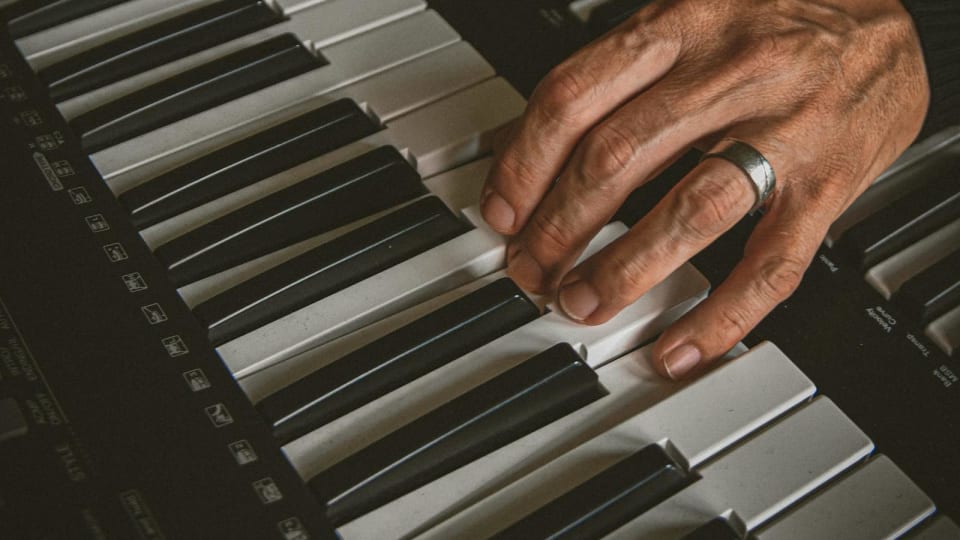 Practice Methods
How to Memorize Piano Pieces Faster: 5 Methods That Actually Work
Want to memorize piano music faster and more reliably? These five methods build aural, visual, analytical, and muscular memory, then stress-test the result so it holds under pressure.
8 min read Practice Methods
Why Am I Not Improving at Piano? 7 Reasons You're Stuck
If your piano progress feels frozen, the problem is usually not talent. It is almost always a fixable practice mistake. Here are seven patterns that keep pianists stuck.
7 min read