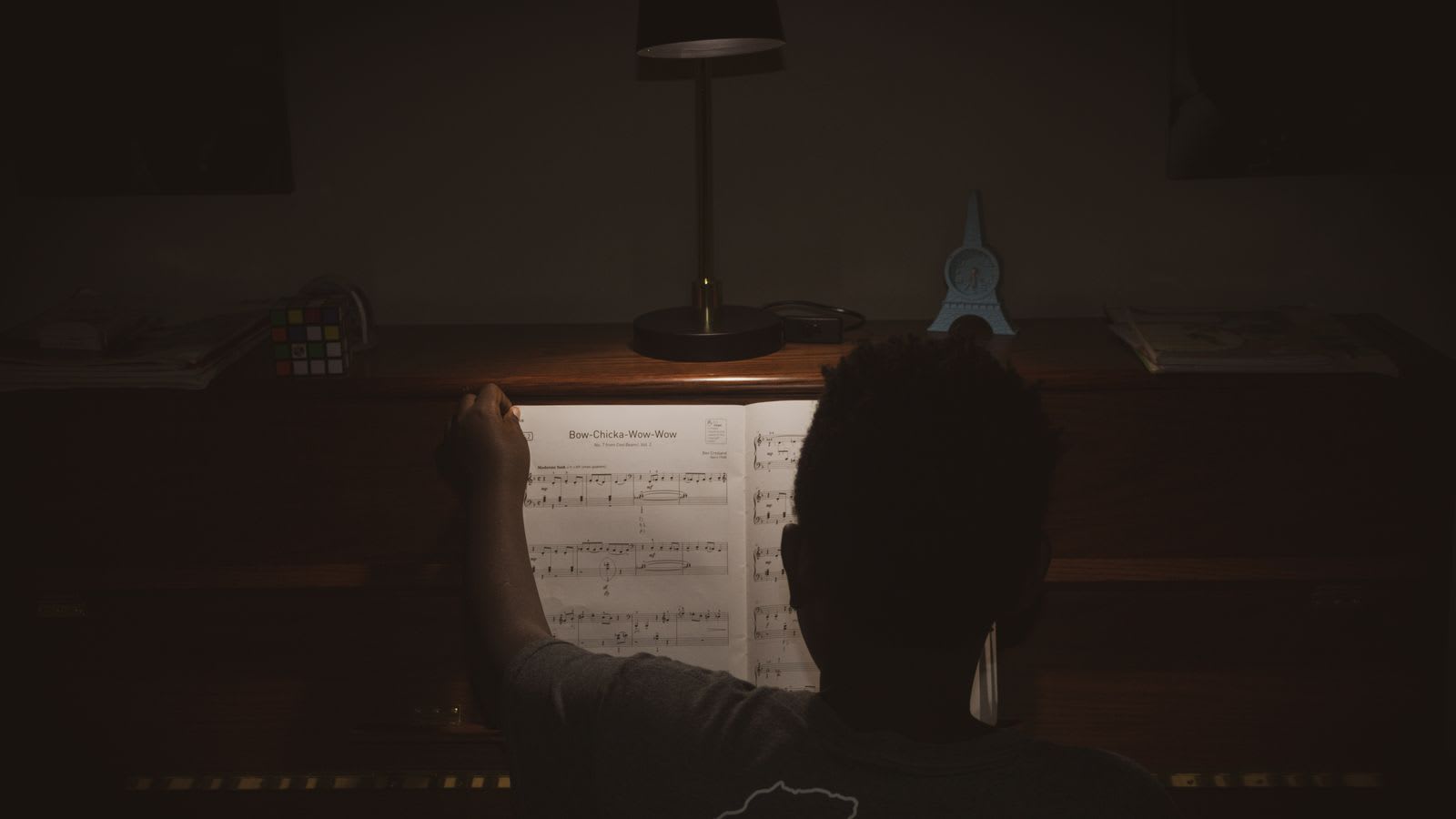
A useful piano lamp keeps an open score evenly legible from the normal playing position. The light source should stay out of direct view, and a polished fallboard or lid should not throw a bright reflection back at the player. Those details matter more than the largest lumen number on the box.
The six lights below cover upright pianos, grand-piano music desks, floor placement, and portable stands. We compared current mounting dimensions, published output and coverage, dimming, color temperature, power, and included accessories. Manufacturer prices were checked on August 28, 2026.
Affiliate notice: Some links are paid links. As an Amazon Associate, we earn from qualifying purchases.
-
Best dedicated upright lampBenQ PianoLight$259 manufacturer price · 2700–5000K · 15 brightness levels · CRI ≥95
-
Best grand-piano clamp lampCocoweb GPLED22D$246 manufacturer list price · 22 in dual-section shade · 2700K · inline dimmer
-
Best no-contact floor lampBrightech Leaf$109 manufacturer price · 53 in tall · 1150 lm · 3000K · three levels
-
Best-value rechargeable clip lightGlocusent 57 LED Music Stand Light$30.59 without case · 11 in bar · three color settings · five brightness levels
-
Best high-output stand lightOn-Stage LED518$83.95 manufacturer price · 430 lm · rechargeable · adapter, cable, and bag
-
Best budget twin-head lightOn-Stage LED204$26.95 manufacturer price · two independent heads · 40 lm · three AAA batteries
Prices shown are manufacturer snapshots checked August 28, 2026 and may change.
Start with the mounting point
The instrument usually eliminates half the field before brightness enters the discussion. An upright has a broad top panel that can support a substantial lamp. A grand offers a music desk that may accept a padded clamp, but the desk still needs to slide and lift normally. A portable digital piano often has a thin plastic rest, and a heavy clip can make it flex.
| Mounting style | Works well with | Measure or check first | Typical trade-off |
|---|---|---|---|
| Weighted top lamp | Acoustic uprights with a flat, stable top | Top depth, hinge position, rear strap route | Broad coverage, substantial size and cost |
| Music-desk clamp | Grand pianos and sturdy wooden music desks | Desk thickness, clamp depth, felt condition | Excellent page alignment, added load on the desk |
| Floor task lamp | Grands, digitals, shared instruments | Head reach, base position, cable path | Touches no finish, takes floor space |
| Lightweight clip | Portable keyboards and music stands | Jaw opening, stand stiffness, loaded balance | Portable and inexpensive, smaller beam and battery |
A clamp rating only tells part of the story. The lamp's weight and forward reach also create leverage on a thin stand. Our guide to music stands explains why a rigid bookplate handles accessories better than a folding wire desk. For a complete first instrument area, the beginner piano setup guide covers stand height, seating, headphones, pedal, and room placement together.
Dedicated lamps for upright and grand pianos
BenQ PianoLight: wide, controlled coverage for an upright
The BenQ is the most thoroughly specified dedicated piano lamp in this group. Its 24.7-inch body sits on the top of an acoustic upright and is secured with a rear safety strap. BenQ publishes a 500-lux score coverage area of 42 by 29.7 cm, the size of two A4 pages side by side, plus key coverage of 123 by 15 cm at 300 lux or more. At the manufacturer's 70 cm measurement height, BenQ reports 720 lux at the center of the score and 1070 lux at the center of the keys.
Those figures describe a very different job from a small book light. The PianoLight has six color settings from 2700K to 5000K, 15 brightness levels, CRI of at least 95, an ambient-light mode, and presence sensing that can switch the lamp off after the player leaves. A hood shields the LEDs from the player's normal sightline. The controls also save a preferred brightness and color setting.
Its limitation is compatibility. BenQ specifies the model for acoustic uprights, and the safety strap forms part of the installation. It is a poor candidate for improvising on a grand or a slim digital console. The integrated light source makes the lamp a whole-unit purchase; it does not accept an ordinary replacement bulb.
Cocoweb GPLED22D: a warm dual-section bar for a grand
Cocoweb takes the opposite physical approach. The felt-lined clamp grips a grand piano's music board from 3/8 to 1.5 inches thick. Its 22-inch shade is split into two independently rotating sections, so one side can be aimed across the score while the other reaches toward the keys. The lamp is fixed at a warm 2700K and CRI above 90, with an inline dimmer on the ten-foot power cord.
Measure the music desk itself, including any shaped lip or trim, before ordering. The padded pressure surface needs to sit flat, and the lamp cannot interfere with removing or sliding the desk. Players who use three loose pages may appreciate the 22-inch span. Someone who regularly switches between warm evening practice and cooler daytime light will miss adjustable color temperature. Cocoweb marked its own store inventory sold out when we checked on August 28.
A floor lamp leaves the instrument alone
Brightech Leaf: a practical general-purpose floor option
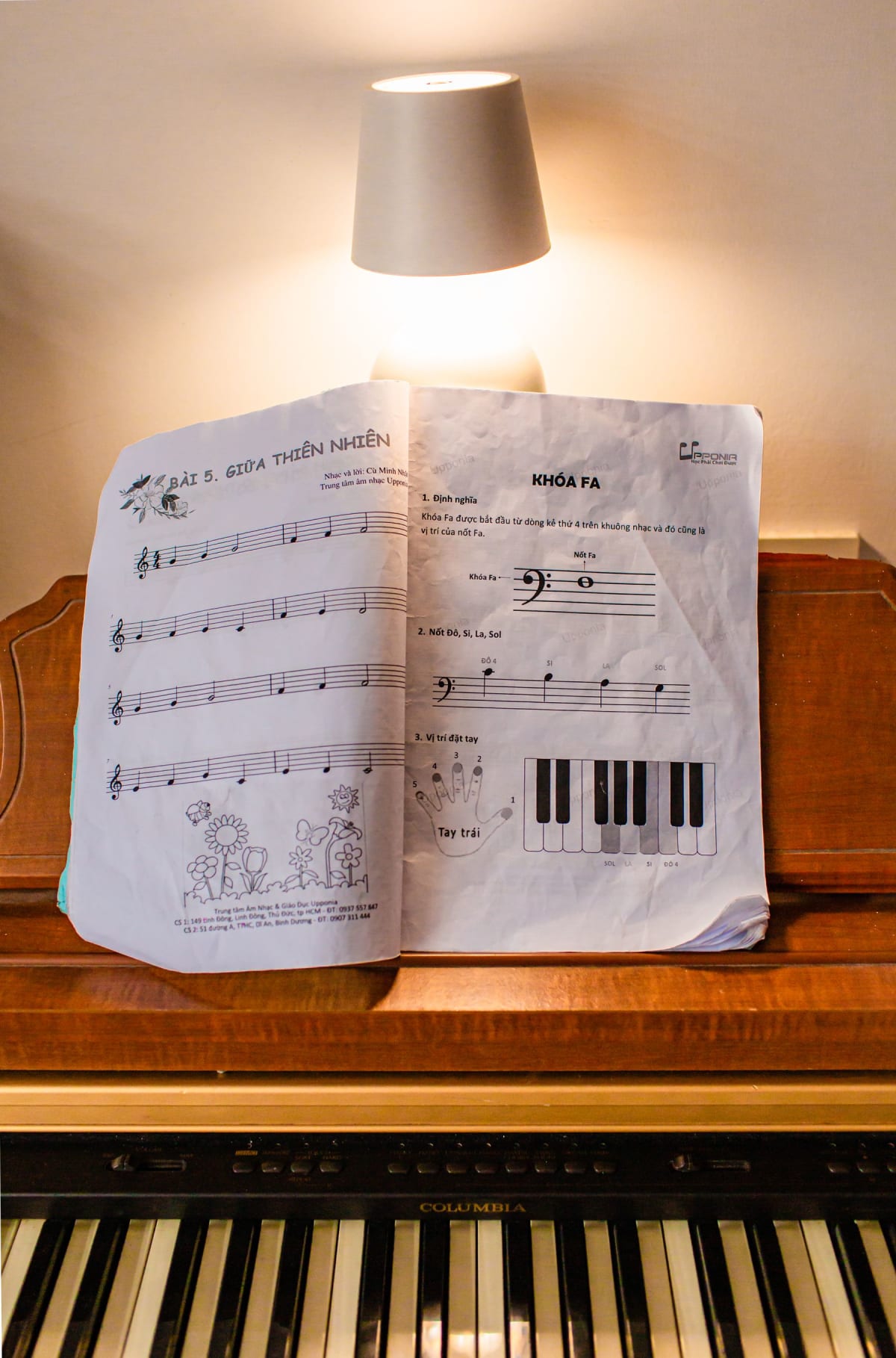
The Leaf is a general pharmacy-style task lamp. That makes it useful for a grand with a delicate music desk, a digital piano used by several people, or a rental instrument where nobody wants a clamp on the finish. The lamp stands 53 inches high, and its pivoting head and swing arm bring the beam over a shoulder or around the side of the piano.
Its integrated 12.5-watt LED produces a published 1150 lumens at 3000K, with three brightness levels. Total output is ample, though the narrow pharmacy shade will not automatically illuminate all 88 keys or both page edges. Placement determines the result. The base belongs to the side of the bench, beyond the player's normal route to the pedals, with the arm high enough to clear a page turn.
This is also the easiest light here to reuse at a reading chair or desk. Sharing it between two players is less convenient because moving a weighted base and resetting the arm takes longer than nudging a clip light. Brightech lists a five-year warranty for qualifying direct purchases, and the LED is integrated.
Rechargeable and portable music stand lights
Glocusent 57 LED: broad control at a modest price
The Glocusent combines an 11-inch bar with five brightness levels and three color settings: 1800K, 3400K, and 6000K. That range is unusually flexible for a low-cost clip light. Its 1.4-inch padded clamp can also act as a freestanding base on a suitable flat surface near the score. The built-in 4000mAh battery charges over USB-C, and the maker claims roughly 10 hours at the brightest setting and up to 140 hours at the dimmest.
The long runtime is a best-case range, and the product page publishes conflicting lumen figures. Actual two-page coverage during the return window is the useful check here. The warmest 1800K mode is very amber; 3400K is likely to look more natural on paper in a living room, while 6000K has the cooler appearance found in some stage and work lighting. A power adapter is not included.
On-Stage LED518: much more output for a dark stage
On-Stage rates the LED518 at 430 lumens from 18 LEDs. The hooded head is intended to cover two side-by-side pages without throwing light toward an audience, and the gooseneck can be clipped to a stand or placed on a flat surface. It has two brightness levels, a fixed 6000K color, a rechargeable battery, and a claimed 10-hour runtime on high or 20 hours on low. The USB adapter, cable, and carrying bag are included.
That fixed cool white is functional under stage lighting but can feel stark in a warm room. The LED518 also costs almost three times as much as the Glocusent. Its carrying bag, higher published output, and complete charging kit make more sense for rehearsals, pits, and performances than for an upright that never leaves home.
On-Stage LED204: two small beams on a budget
The LED204 is the blunt economical option: two independently switched heads, two brightness levels per head, 40 lumens total, and three included AAA batteries. Separate goosenecks help with scores whose center fold casts a shadow, and one head can be switched off for a single page.
There is no rechargeable battery and no power adapter in the box. On-Stage documents an optional 5V adapter, so a permanently installed home light may acquire an extra cable and purchase. For occasional lessons or a backup kept in a music bag, ordinary replaceable batteries can be simpler.
How much light should reach the score?
Lumens describe total output from a source. Lux describes the light arriving on a surface. A high-output lamp placed too far away can leave a score dim, while a lower-output bar close to the pages can make them bright but uneven.
OSHA's workstation guidance places paper tasks around 20 to 50 foot-candles, approximately 215 to 538 lux. UK workplace lighting guidance uses 500 lux for fine-detail work. The figures offer useful scale without setting a requirement for a home piano. About 500 lux across the open score is a sensible starting point.
The phrase “across the score” is important. Take readings near the outside edge of each page as well as the center if a lux meter is available. A phone app is useful for comparing positions with the same phone, although it should not be treated as a calibrated instrument. Dense miniature notation, low-contrast photocopies, and older readers may call for more light. More output can also make glare worse, which is why a dimmer and a broad beam are more useful than one very bright setting.
Leave some ambient room light on. A white page floating in an otherwise black room creates a large brightness change whenever the eyes move toward the keys, teacher, or pedal markings. The surrounding area can remain subdued without disappearing completely.
Color temperature, CRI, and flicker
Color temperature describes the appearance of white light. A 2700K lamp looks warm and slightly amber. Around 3000K to 4000K tends to sit comfortably in a home. A 5000K or 6000K source looks cooler and can appear stark when the room's other lamps are warm. Preference, room lighting, and time of day all affect the choice.
Kelvin is not an eye-safety score. The US Department of Energy's LED primer separates color temperature from color rendering, and recommends CRI 80 as a general indoor baseline. CRI 90 or higher is pleasant when a score contains colored pencil, highlighter, or tinted paper. Ordinary black notation depends far more on page illuminance, contrast, and reflections. The CIE's position on blue-light hazard also distinguishes ordinary white-light use from the extremely bright sources involved in retinal hazard.
Flicker depends on the LED driver and may change at different dimmer settings. A maker's “flicker-free” label is most informative when a test method or metric accompanies it. The Department of Energy's flicker research explains why one number cannot describe every temporal effect. Slow-motion phone video may reveal obvious pulsing or dark bands. It is a screening check and cannot provide a laboratory measurement. Test the dimmest setting as well as full output.
Set the beam from the bench
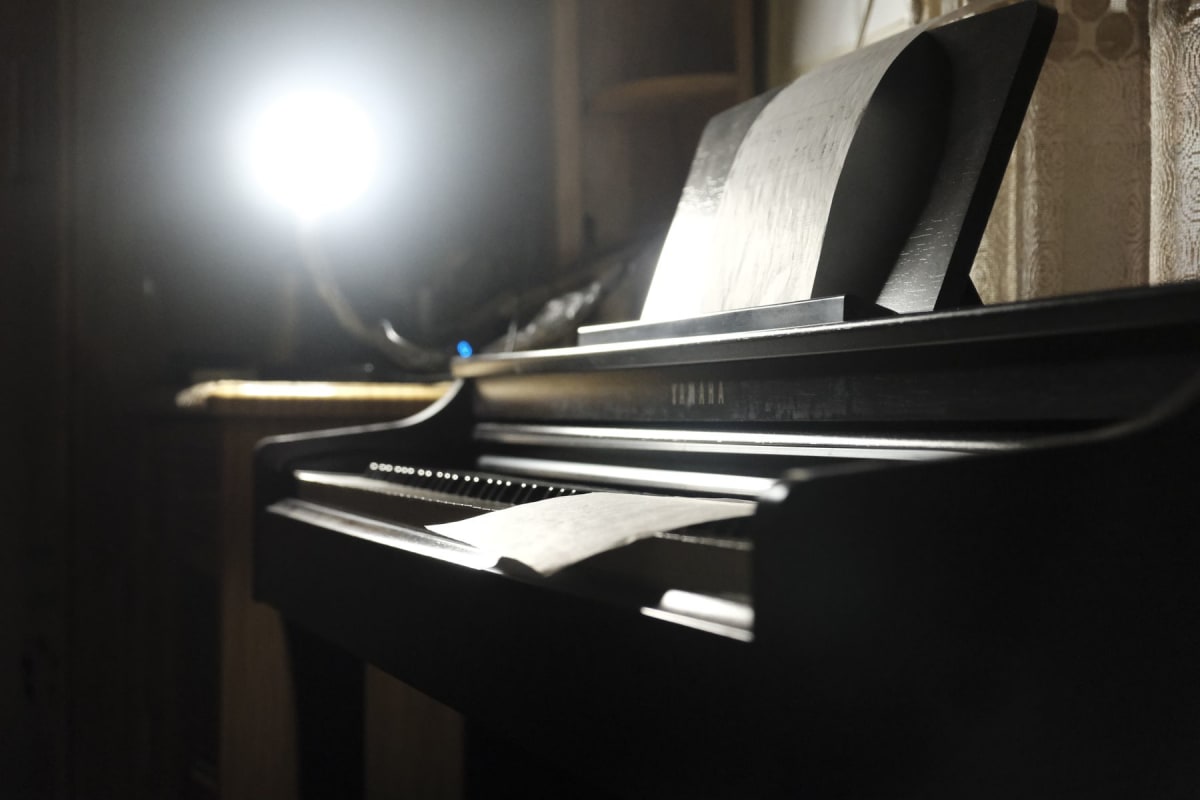
Glossy black casework acts like a dark mirror. A lamp can illuminate the page well and still create a distracting copy of itself in the fallboard, cheek block, or raised lid. The player's viewing position is the best place to judge that reflection.
- Pass 1Sit at playing height. Can you see bare LEDs or the bright bulb?If yes, lower the head or tilt the shade until the emitter disappears.
- Pass 2Scan both pages. Do the outside staves or lower systems fade?Raise, widen, or re-aim the beam before increasing brightness.
- Pass 3Look at the case. Is there a bright reflection behind or below the score?Shift the source sideways, change its angle, or dim it one step.
- Pass 4Turn a page and play. Does a hand hit the lamp or cast a moving shadow?Add clearance and check that the new position still passes the first three tests.
Plastic sheet protectors and glossy tablet screens add another reflecting surface. For paper, try removing a shiny sleeve before buying a stronger lamp. A tablet produces its own light, so the room lamp should support the keys and surrounding area without reflecting across the display. Our iPad sheet-music setup covers stands, pedals, and screen positioning.
Finish with a safety and return-window check
A piano creates several cable traps. Route the cord where the fallboard, lid, music desk, bench legs, and pedals cannot pinch or pull it. Keep the floor-lamp base outside the player's footpath. The US Consumer Product Safety Commission advises replacing damaged cords, keeping them out from under rugs and furniture, and avoiding extension cords as permanent wiring.
For a clamp lamp, confirm that both pads are intact and clean, the jaw sits on a structurally suitable part, and normal desk adjustment remains possible. When shopping, look for a genuine certification mark from a recognized testing laboratory such as UL or ETL, and check whether it applies to the whole lamp or only its power adapter. Rechargeable models should use the supplied or approved charger on a hard, ventilated surface, away from the piano's finish and other combustibles.
Test a new lamp after dark with the room arranged as it is during practice. Use a dense score, a pale photocopy, and any glossy sleeve or tablet that appears regularly. Read the top and bottom systems, turn pages, move from bass to treble, use all pedals, and try every dimmer setting. Players who need increasingly bright light can also benefit from larger print and an up-to-date vision check; age-related vision changes can increase both light needs and sensitivity to glare.
Keep the packaging until those checks are complete. A lamp that looks bright from across the room can still miss the lower stave from the bench. If both pages remain even through normal head movement and page turns, the mounting and beam are working for the actual setup.